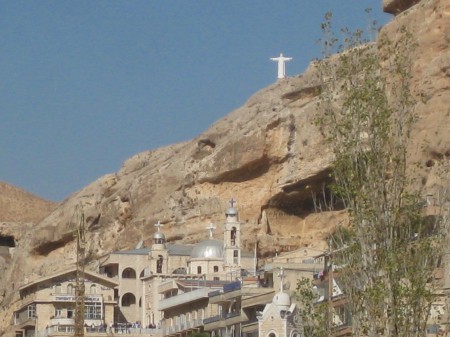
The following article appeared on a Syria blog I follow. It caught my attention because I have been to this historic town called Ma'loula. I feel devastated to hear of the possible destruction that has taken place there. I think everything going on in Syria makes me mourn for the country like it was a person who is slowly dying of some awful disease. All of this person's unique attributes are slowly disappearing as they slowly get worse and worse as the disease takes over their body. Hearing about the town of Ma'loula especially saddens me since it is one of the only remaining places to speak Aramaic, a dying language, thought to be the language Christ. It is believed that the language preceded Arabic and Hebrew. I remember going to this town and seeing all the caves in the side of the mountains (like the ones pictured below). I stood at the Hotel Safir at the top of the mountain and overlooked the whole valley (you can see the hotel in the pictures below). I walked through the Christian church at the top of the mountain as well which is partly in a cave and has been in operation for thousands of years. I spent the whole afternoon with a family picnicking in the ravine near the town. In the entrance of my home, I have framed the Lord's Prayer which I bought in Ma'loula. It is written in English, Arabic and Aramaic. I am so sad to hear about the loss of this historic place and all the artifacts and Aramaic speakers who are being lost with it. I have not thought about much else today. I have spent hours going through old photographs looking for the pictures I took when I was there. This is really upsetting to me....
Posted by Matthew Barber on Thursday, September 5th, 2013

A hard-to-reach tomb in Ma’loula, Syria. Photo: Matthew Barber / Syria Comment
Jabhat al-Nusra and Other Islamists Briefly Capture Historic Christian Town of Ma’loula

By Matthew Barber for Syria Comment
Ma’loula (or
Maaloula) is one of those unique places you may
be lucky to visit—or perhaps were lucky to have visited, were you
fortunate enough to have been in Syria before the conflict began. An
ancient town in a hollow encircled by mountain cliffs descending from
their heights to offer shelter to the homes built directly against their
sides… exploring its many secrets is to be transported back in time.
Ancient monasteries, old churches, rock faces with cave dwellings and
tombs—the place is brimming with rich historical treasures.

Ma’loula, Syria. Photo: Matthew Barber / Syria Comment
Ma’loula is also unique for being among the minority of Syrian towns
where Christians comprise a majority, though this status has by now
eroded to the point where Christians are only a slight majority. Still,
the town represents the survival of the Christian community stretching
back to the early days of Christianity.
A Church in Maaloula. Photo: Kellie Stirling / Syria Comment
But the cultural wealth preserved in the town precedes Christianity;
Ma’loula is one of the last places on earth where the pre-Christian
language that once dominated the Near East, Aramaic, is still spoken. In
use from almost 1000 years BCE, Aramaic was the most important language
of Syria, Palestine, and Mesopotamia by the time Christianity entered
the scene. Aramaic remained the
lingua franca of the Near East
until its ascendent position was supplanted by Arabic when Islam spread
east, west, and north from the Arabian Peninsula. Aramaic had been an
important language for conducting trade from Egypt to the borders of
India, until the arrival of a sacred text—the Qur’an—whose effect was
strong enough to issue the challenge that its own language take the
place of most important tongue.
The dialect used in Ma’loula is labeled “Western Aramaic,” and is now
only spoken in this small city and in two neighboring villages. A few
years ago, President Assad began to
officially support
the efforts of Ma’loulans to conduct language preservation through
Aramaic education programs in local schools. Though the generous
Ba’athists never extended this right to the Kurds, it was a positive
step toward strengthening the health of the local culture of Ma’loula.
But yesterday, both the actions of Syrian rebels, as well as the
response of the regime, will have the opposite effect on this fragile
community.
Today, the position of such highly endangered languages is made more
precarious by instances of violent conflict. It is important to note
that most speakers of Aramaic dialects—Eastern and Western—are
minorities: Christians, Jews, Assyrians, Chaldeans, and Mandeans. We’ve
been able to observe clearly the destructive toll that conflict in the
Middle East takes on minority and Christian communities, a phenomenon
that unfolded before the world’s eyes in Iraq, and which has also been
recently intensifying recently in Egypt. As the Syrian conflict has
developed, we’ve also seen that minority Christian communities are often
some of the most vulnerable segments of the population, and their
numbers have already vanished from many of their cities, after fighting
has become intense, or after rebels gained control of their areas. Being
caught between warring factions, as well as a sense of exclusion
experienced as non-Muslims when something that Islamists call “Islamic
law” is implemented, prompts many Christians to emigrate from their
homelands in the Middle East.

Ma’loula, Syria. Photo: Matthew Barber / Syria Comment

Image: New York Times
The Syrian conflict has certainly affected every Syrian to some
degree, but it affects some areas more than others. Many towns have
still managed to escape direct involvement, but given enough time, the
conflict manages to find its way to everyone’s doorstep.
Until yesterday, the community in Ma’loula had avoided the direct
presence of the conflict, but that all changed in the early morning
(Wed., Sept. 4, reportedly around 5:30 am) when a Jordanian
suicide-bomber
named Abu Mus’ab al-Zarqawi (yes, same name as the famous al-Qaida
figure) detonated a car bomb at the checkpoint guarding the entrance to
Ma’loula, killing the soldiers there and allowing al-Qaida-linked rebels
to roll into town in 20 pickup trucks with machine-guns mounted in the
back.
Here’s a photo of the bombing of the Ma’loula checkpoint from Jabhat al-Nusra:

Nusra also posted photos of the bodies of the soldiers they killed at the checkpoint:

The following video shows rebels in the center of Ma’loula, firing
weapons. It’s not clear if they are firing at specific targets, or
merely announcing their arrival by firing into the air. Regardless, it
was quite effective in terrorizing the local inhabitants.
And another video shows the rebels declaring their capture of the town after entering:
The video and photographic evidence available after the attack
indicates that the operation was a coordinated effort between (at least)
the following groups: Ahrar al-Sham, Jabhat al-Nusra, the Baba ‘Amr
Brigades (a rebel group possibly affiliated with the SIF – Syrian
Islamic Front), FSA Commandos Unit, and Soqour al-Sham. A video from
Ahrar al-Sham can be found
here. A video of shooting, apparently as part of the initial attack, is
here.
My own Ma’loulan sources tell me that displaced people from Duma
(between Ma’loula and Damascus) had taken up residence in Ma’loula, and
cooperated with the rebels to facilitate their entrance. Ma’loulans now
resent them for acting as a 5th column inside the very community that
gave them shelter when they fled their own town as refugees. The danger
with such cases is that it will generate suspicion and ill-will toward
refugees generally.
Other photos of rebels posted online after taking Ma’loula can be found
here,
here, and
here.
One poster of photos from the operation to take the checkpoint refers
to the soldiers as “apostates.” One poster seems to be from Somalia
(unknown if he participated in the attack).
A Facebook
page
shows an alleged photo of one of the soldiers killed in the attack.
Reportedly, at least 8 soldiers were killed on the first day.
Ma’loula only has one mosque. When the rebels entered the city
center, they went to that mosque to declare victory and perform a
typical chorus of
takbiir (the shouting of
Allahu Akbar).
According to Ma’loulans I spoke with, the attack involved two fronts.
After the checkpoint was disabled, the Safir Hotel, located on the
rocky cliffs overlooking the city, was appropriated by the rebels, who
used it as a staging point for shelling. Some have said that they
shelled the city from there; it seems that shells were fired from
outside the city, as well.
The Safir Hotel can be seen atop the cliffs in the following two
images. The strategic value of the site for anyone wanting to attack the
town is obvious:

Ma’loula, Syria. Photo: Matthew Barber / Syria Comment

Ma’loula, Syria. Photo: Matthew Barber / Syria Comment
After the Islamist-led rebel alliance took the town, the Syrian
regime responded by sending in aircraft to attack the rebel positions.
This is the ever-disastrous pattern to the Syria conflict: rebels take a
town doing its best to mind its own business, and the regime comes to
the defense of the town and destroys it in the process. I spoke
yesterday with a Syrian Christian who traveled near Ma’loula during the
time of the attack. Like many Christians in the country, he has no love
for the oppression of the regime, but remains somewhat “pro-regime” in
relation to the conflict, since the threat of Islamists showing up and
taking over his town outweighs his dislike of the regime. I asked him,
“Regardless of the fact that these rebels invaded uninvited, would it
not be better for the regime to just leave them alone, rather than
conducting an airstrike on one of the most historical places in the
country?” He responded sadly: “They don’t care. They will destroy
anyplace the rebels are to be found.” He reminded me of other historical
treasures that have been damaged through the regime’s response to rebel
incursions, such as occurred in Palmyra, and recently at the Qal’at
al-Hosn (Crac des Chevaliers), a magnificent Crusader castle and
important tourist attraction that the regime bombed after rebels set up
base inside. For someone who has defended the regime’s side during the
conflict, his attitude of exasperation toward the scale of their
responses was telling. Still, residents of Ma’loula have expressed
gratitude for the military reinforcements sent in to expel the unwanted
rebels. Many in Syria still prefer the devil they know to the one they
don’t—though they’re getting to know the latter all the same.
Footage of a helicopter filmed by rebels discussing whether to try shooting it down can be found,
here.
After the regime’s counterattack, the rebels withdrew back inside the
Safir Hotel. Initial reports said that after a 3-hour battle the
military was able to drive the rebels out of the town. Today this has
proven to be otherwise; rebels remained in the hotel all night and all
the next day, and fighting resumed around 6:00 pm today, when rebels
conducted another attack. The rebels lost the town yesterday in the
sense that those in the city center were driven out, and only those in
the hotel were able to remain. But the presence of rebels was not
eliminated, as hostilities resumed today. Today’s fighting was allegedly
more intense, as rebels moved through the alleys between homes,
shooting. Apparently, young residents of the town tried to defend their
areas even though they lacked weapons, and some were injured when
standing up to the rebels.
The big question is: Why Ma’loula? What need is there for rebels to
capture this town? Talk of “liberation” certainly has no currency when
the local residents aren’t asking for any and would prefer to be left
alone. Was there any strategic importance to the town? Or was it merely
an easy target for “victory,” not well-guarded and unable to resist
being taken over? Some have suggested that taking the town was needed in
order to link to opposition resistance efforts in the nearby Qalamoon
region. Jabhat al-Nusra’s
official account,
however, referred to the attack as part of the “Eye-for-an-Eye” revenge
campaign, initially declared after the chemical weapons attacks in the
Ghouta.
Al-Jazeera’s
reporting
was one-sided, as usual. It explained the attack exclusively in
strategic terms, noting the town’s connections to other nearby
communities with a rebel presence. They failed even to mention Jabhat
al-Nusra’s presence in this campaign, instead referring only to the
FSA’s involvement and ignoring the central role of Islamists in the
operation.
When the rebels first came into the town, they reportedly told people
“Don’t be afraid; stay inside your homes.” A video posted online by
the Katibat Souwar Bab ‘Amr shows a rebel
speaking to his men, affirming that (paraphrase, not verbatim):
We don’t shoot at any church or at civilians; we’re only
here to push back against the oppression and will only target those who
target us. They (the people of the town) are our people and part of our
country. The regime has persecuted everyone, from all sects. Here we are
in front of the church and everything is safe and the houses are safe.
Despite the affirmation of goodwill toward civilians and the pledge
to not harm churches, I was told that the first mortar fired by rebels
hit a church. Since then, others have conveyed to me that churches and
monasteries have been damaged in yesterday and today’s fighting. Even if
the damage is unintentional, local residents will likely not feel very
understanding toward their uninvited “liberators.” I was told that at
least some of the rebels cursed some Christians and threatened to kill
them for being infidels. The rebel speaking in the video quoted above
may reflect one group’s approach to taking the town, but several groups
with different ideologies were participating, and Nusra’s presence
confuses things. When Nusra’s revenge campaign began, many threats were
voiced against towns and civilians. Though it seems that civilians
survived largely unscathed in the events in Ma’loula, it is
disconcerting to see the attack associated with a revenge campaign. One
of Nusra’s
photos
for the attack on Ma’loula was published on Facebook with a verse from
the Qur’an stating: “Allah give us patience and victory over the
infidels”—perhaps not the best slogan to use when launching an
al-Qaida-led attack in which a Jordanian Islamist blows himself up at
the gate of the oldest Christian village in the country.
It is hard to know how unified they were on their post-invasion
behavioral code, but we have more than one report (including from my own
contacts) alleging that multiple churches/monasteries were damaged
and/or ransacked. Reports online of churches burned in Ma’loula are
false and can be attributed to propaganda sources with a pro-regime
orientation, exaggerating the degree and kind of damage that occurred.
However, my own source alleges that the Mar Taqla monastery was hit with
two shells, and there are varying reports of other attacks. Three
articles on Lebanese and Syrian websites offer conflicting reports on
exactly which churches were damaged:
1,
2,
3.
In one of them, the Melkite patriarch is quoted claiming that rebels
broke into multiple Christian homes and churches, burning crucifixes and
icons. The other two articles give conflicting accounts of the report
received by the head nun of the Mar Taqla Monastery. One account has her
claiming that 15 nuns and the orphans they care for had to sleep inside
of a cave in the mountain, while the other has her claiming that the
monastery was not attacked.
While we’re waiting for more details on the actual damage, my
contacts claim to be certain that Ma’loula’s Aramaic Language Education
Center (an institute that works for the preservation of the language)
was broken into by rebels and looted.
There are no details on what was stolen, but that this particular
institution would be targeted seems to underscore the earlier point
about the vulnerability of religio-linguistic minorities. This
vulnerability is what has prompted Pope Francis to
issue a statement today to the leaders of the G20 countries, opposing military intervention in Syria.
… amid the U.S. threat of military intervention, Vatican
and church officials have warned that a world war could erupt, with
Christians in the region bearing the brunt of the fallout…
Though many details on this story need further clarification, one
thing is certain: the situation led to the fleeing of many Ma’loula
residents to Damascus. An area that previously received refugees is now
sending out its own, and the dwindling numbers of Aramaic-speakers are
no longer comfortable within their remote mountain fastness.
—————————————-

Ma’loula, Syria. Photo: Matthew Barber / Syria Comment
For an interesting read about Ma’loula during the conflict, see
this article by Robert Fisk.


