I read the following article on a Syrian blog I follow the other day and it put a smile on my face remembering the times when I was learning to ride the microbuses in Damascus and Aleppo. I remember how proud I was of myself when I "mastered" the transportation system with no maps, no timetables and no ticket offices. I could confidently hail a microbus or find the right one going my way underneath the freeway overpass in the sea of microbuses there. More pride in myself as I learned to pay the correct fare and then yell to the driver when it was my time to get off. It was an amazing system without a system. It was always interesting to see who would hop on and off and how many people they would cram into the seats. It brings so much sadness to me to think of the Syria I once knew, now at war....
The End of the Line: A Microbus Map of Damascus
by Matthew McNaught
1.
Here is a Syrian microbus, more commonly known as the
servees or
micro:
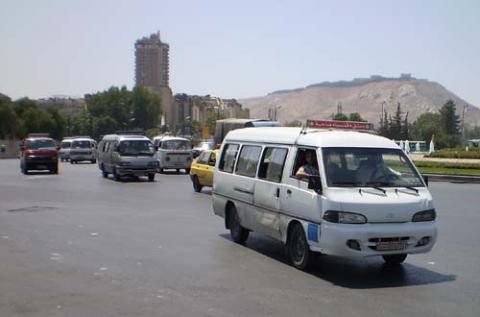
As you can see, it doesn’t look like anything special. A white box on
four wheels, about ten seats, a sliding door on the side, a sign on the
roof with the route written in large letters. But three years after
leaving Damascus, the servees is often on my mind.
I went to Damascus at the start of 2007 with a plan to study Arabic
for a year. The city won me over, and I decided to stay on. I worked
there as an English teacher until the end of 2009.
Some days, I still have pangs of nostalgia for the servees. When I am
waiting at the bus stop on a wet Southampton morning, for instance,
watching the back of the bus I’ve just missed as it disappears around
the corner. When I look at the timetable and see I have thirty minutes
till the next one. This is the kind of time when I indulge myself: I
imagine for a moment a battered white servees sailing down the street
towards me. I see myself flagging it down, pulling open the clunking
slide door with a mumbled
salaamu ‘alaykum, and riding the micro again.
Riding the micro is one of the most efficient ways I have known of
getting around a city. It came regularly, responding to demand at busy
times but also running late into the night. You could flag one down
wherever you were, and you could get off wherever you wanted. They drove
fast, weaving through traffic at bum-clenching speed. They were also
absurdly cheap. When I first arrived, you could ride the servees five
times for the price of a falafel sandwich. Sometime in 2009, the fare
doubled, but it remained so cheap that even regular rides failed to make
the slightest dent on my wallet. But it was not just the practical
advantages that made me love the servees. It also had less tangible
charms.
2.
Riding the servees was not easy for beginners. You first had to be
initiated into its mysterious ways. I met the first hurdle when I
discovered, to my surprise, that there were no maps of the different
routes. There were no timetables, no central ticket offices. There was
nothing but the minibuses themselves, snaking and swerving through busy
streets, each heading in a winding line towards the final destination
painted on the sign on its roof. The routes seemed to have always been
there, as if they had emerged organically, like sheep-tracks or the
paths of migratory birds. It seemed that every Damascene carried a
microbus map in their head, like the knowledge of a London cabbie. But
as a foreigner, I had to construct my own map, one line at a time.
In the beginning, my mental map of Damascus was a stubby little
thing. It was a Lonely Planet Damascus, a wandering line from the
ancient souqs of Old Damascus to the hotels and banks of the modern city
centre, punctuated by famous ice-cream parlours, cheap restaurants and
historic bathhouses. It was enchanting, but I wanted to see more. When I
figured out how to navigate the servees lines, the larger city began to
open out in front of me.

My servees apprenticeship began outside Bab Sharqi, the eastern gate of the old city. The first servees I took was the
Jobar-Mezze line
, which
took me through the heart of the modern city to my Arabic classes at
Damascus University. I would stand at the edge of the pavement, beneath
the ancient stone tower. Nancy Ajram, the botox-enhanced Lebanese pop
star, towered over me on a giant billboard across the road, seductively
enjoying an ice cold Coca-Cola. The main road roared with several lanes
of traffic that skirted around the Old City walls. The bend in the road
gave me about 5 seconds to identify the right
servees after it came speeding around the corner.
This was, I discovered, an excellent exercise in speed reading. As a
beginner, you don’t read Arabic, you decipher it, picking apart each
word letter by letter, brain straining and lips moving. But when the
word is hurtling towards you on four wheels, you do not have that
luxury. You have to be primed, ready for its shape; the swooping arms of
the
waw,
raa and
zaa, the dotted cap of the
taa marbuta. With time, the names of the various
servees
routes came to occupy a special place in my brain, their shapes burned
into my memory as some of the first Arabic words that I read as a native
speaker reads —
Ghouta, Qaboun, Midan-Sheikh, Duma, Barzeh, Harasta, Yarmouk, Jobar-Mezze.

3.
For its passengers, the
servees was simply a convenient way
of getting from A to B. But it was also, inadvertently at least, a kind
of meeting place. A place where Syrians of all ages and backgrounds came
together for a moment, in an awkward shuffle of elbows and knees,
before heading off their separate ways.
For this reason, riding the
servees was an education for a
foreigner like me. It seemed like all Syria was there. There would be
manual workers in dusty work clothes alongside civil servants with
shirts and briefcases. Chattering college girls, some in grey overcoats
and tight white hijabs, others in jeans with their hair down. Old men in
thaubs counting on prayer chains, and large housewives in black abayas
with hijabs pinned above the chin; teardrop frames for pale faces.
The seats of the
servees would soon fill up, but it seemed that a sacred rule of
servees
drivers was that there was always room for one more. As passengers, it
was up to us to find imaginative ways of tessellating. It was times like
this that reminded me that the Turkish name for the
servees
was ‘dolmuş’, meaning ‘stuffed’. Squatting awkwardly on the slippery
hump above the back wheel, tightly pressed between one man’s legs and
another man’s bottom, it was hard to dispel the feeling that we were the
meaty stuffing in a tightly-packed aubergine.

Service interior – Photo: Matthew Barber/Syria Comment
But on other days, I would be lucky enough to find my favourite spot —
the window seat directly behind the driver. Here I could lean my head
sleepily against the window and stretch my legs (or at least not have
them jammed up against my chin). If I was lucky, I would get to listen
to the driver telling some anecdote to the passenger in the front seat. I
rarely understood much, but I enjoyed the familiar phrases that would
pepper the stories:
I swear to God. By the prophet. You’ve gotta be joking. I’m serious, man.
4.
On an English bus, the passenger is a passive creature. The rules are
simple: you pay your fare, you sit and you mind your own business. But
riding the
servees felt like joining a fleeting community.
Despite the chaos and the bustle, the
servees was often a
place of small kindnesses and civility. Men would give up their seats
for women and the elderly. People would help the frailer passengers on
and off. And there were rules pertaining to specific places in the
servees.
The person sitting nearest the door, for instance, would make sure that
it was properly shut after every stop. And the one place I learned to
avoid was the aisle seat behind the driver.
The first time I sat there, I was shocked to find myself bombarded
with coins and notes from other passengers. I felt a rising panic as a
woman pressed a 25 lira piece into my hand, saying ‘two fives’. A man
then handed me a 50 lira note and a 5 lira piece, muttering ‘three fives
and a five’. I realised that the passenger sitting there had the job of
receiving fares from passengers, handing them over to the driver and
making sure everyone got the right change passed back. I was up for
language challenges, but a maths problem and a language problem wrapped
up in one was more than my poor brain could take. A kind woman next to
me noticed my bewilderment and sorted out the mess, and I made a mental
note to never sit in that seat again.

Any visual impairment? Photo: Matthew Barber/Syria Comment
Drivers were remarkably relaxed about when you paid the fare, as long
as it reached them before you arrived at your destination. However,
when I rode the service with Syrian friends, I soon learned that they
would go to great lengths to stop me from paying my own fare. This
appeared to be a common Syrian trait; I once saw two elderly ladies on a
servees getting into a physical altercation over who paid. I
let my friends win this battle a few times, but soon I learned to be as
ruthless as them. I would prepare the change for both of us in the palm
of my hand before the
servees arrived, ready to make a lunge for the driver on the way to our seat.
Learning the language of the
servees was also essential. As
there were no fixed stops, you had to shout to the driver when you
wanted to get off, something that initially made me very anxious. The
first time I tried, I half-shouted to the driver from the back seat in a
formal phrase straight from my Modern Standard Arabic textbook: ‘
uriidu an anzil hunaa!’
When he didn’t respond, I repeated myself, shouting louder each time
until he eventually pulled over. For some reason, this display prompted
many stifled giggles in my fellow passengers. I only realised the reason
for this when a Syrian friend told me that it was roughly comparable to
yelling ‘VERILY, I WISH TO ALIGHT!’ on an English bus. After this, I
quickly learned how to do it like a Damascene, with the standard phrase:
‘al yamiin!’ meaning ‘on the right!’.
But one day as I was riding the
servees, I heard a man say
something slightly different to the normal phrase. He was a big man,
thick-set and stubbled, and he crouched in the aisle. When we approached
his stop, he shouted ‘
nezzilni, bullah!‘. It meant, literally,
‘let me off, by God’. There was nothing particularly unusual about the
words in themselves, but there was something about the phrase that
pleased me in some indefinable way. It might have been his accent, the
gruff bark and falling intonation of a Damascene working man. It might
have been the assertiveness of it, or its casual grandeur, invoking the
name of God in order to get off a minibus. But to me, it said: here’s a
man who knows exactly where he’s going, and exactly where he’s getting
off.
And so I adopted this phrase. The first few times, it came out in a
timid adolescent croak, and attracted some odd looks. But with time and
practice, I liked to think, it developed into something approximating
that man’s gravel tones.
5.
Once I had overcome these minor obstacles, I couldn’t help feeling a
small buzz of mastery from riding the micro. I flagged them down with
confidence and climbed on with a spring in my step. I would pity my
ex-pat friends who relied on taxis. After a while, I even dared to take
the accountant’s seat behind the driver. And when we approached my
destination, I would bellow “let me off, by God!” and the driver would
pull to the edge of the road without so much as a backwards glance.
I came to enjoy the variety between the micros. Some micros were
tatty, all rusted metal and threadbare upholstery. A few were fitted out
with plush interiors, multicoloured lights and thumping sound systems.
Some had names written on the back window: princess, beautiful, light of
my life. On some, we listened to the recitation of the Quran, the
sonorous voice drenched in holy reverb. On others, it was rural
debke
music, with its abrasive pounding beats and the manic electric organ
that sounded like an overdriven Casiotone with extra black keys.
With time, my microbus map grew to become a tangle of intersecting
lines that joined up different parts of the city that I knew. The
Mezze Autostrad line took me to my friend Jawad’s place, where we would sit on the balcony of his high rise flat, drinking tea and eating lentil
and rice
mujaddara discussing the confounding mysteries of Arabic grammar and the opposite sex. The
Yarmouk line took me to the home of my Arabic teacher, Mazin, whose legendary parties would go on into the early hours. The
Jeramana line took me to the hole-in-the-wall Iraqi bakery where I got my supplies of the pitta-like
samoon and the crispy
tanoori flat-bread, and I would ride the
Midan line to some of the oldest and best restaurants in Damascus, famous for their grilled meats and
fuul beans.

Under the Jesr Ra’is
The
Rukneddine line took me to one of my favourite places,
where the houses climbed steeply up the rocky slopes of Mount Qassioun. I
would ascend the steps past teetering buildings to the path that led to
an ancient shrine that looked out over Damascus. Heading up in the
early evening, I would watch the sun set as the call to prayer from a
hundred mosques hung over the city like a fog.
The micro lines showed me a city of contrast; from wide tree-lined
streets to densely built-up working class neighbourhoods. They showed me
a city of diversity; from conservative Muslim areas to places rich in
minorities; Druze, Ismaelis, Christians and Mandeans from Iraq.
I noticed that you could not get everywhere on the micro; there were blackspots. No
servees
went to the complex of expensive restaurants off the airport road or
the swimming pools and leisure centres on the road to Beirut. They were
places for people with cars. And it was unusual to see a
servees
in the high-class neighbourhoods of Maliki and Abu Roumaneh, with their
jewellers, designer shops and luxury apartments with armed guards.
Micros skirted around the edges and along the main thoroughfares, but
rarely ventured inside.
When friends came to visit, I would insist on getting the
servees
rather than the taxi. ‘I’ll show them the real Damascus’, I would think
to myself, and proudly take them to places outside of the usual tourist
trail. It took me almost three years to feel like I really knew
Damascus. But in the three years since I left, I have begun to realise
how much was missing from my map.
6.
The last
servees that I saw was on the news. It was torn
open like a tin can. There was a bomb near the President Bridge, one of
the main microbus hubs in the centre of town. The
servees had been gutted by flames and its seats were wrenched apart by the blast. There were shoes scattered on the concrete outside.

Service destroyed in Damascus car bombing
Early on in the uprising, news of every bombing, massacre and
military assault left me with a lingering knot of dread and sadness. But
there came a point where the images of destruction began to lose their
power. They hit my visual cortex with a numb familiarity, just one more
item on the news parade: here is shiny-faced Cameron and his hand
gestures. Here is George Clooney on a red carpet. And from Syria:
shrouded bodies, weeping mothers, and the ragged skylines of ruined
streets. The images were horrific in a distant way, but somehow, the
scale of destruction had become too great for me to process. It was as
if a parallel Syria had emerged: Syria the news story, the conflict, the
humanitarian crisis. Meanwhile, the uneventful, everyday Damascus that I
had loved remained intact in my memory, as if I could return to it at
any moment.

Burned-out service – Photo: AP/SANA

Service
burns behind Syrian security agents carrying a man at site of car
bombing near the Baath party headquarters and Russian Embassy in central
Damascus, Feb 21, 2013 – Photo: SANA-AP
The image of the
servees cut through this. It captured the
moment when a familiar and mundane world turned hellish. A normal day: a
school run, a commute, an errand. Mumbled greetings. Three warm bodies
squeezed into each row of seats. The faint smells of aftershave and
sweat, washing powder and cigarette smoke. Coins passed from palm to
palm across the rows to the driver. In Syria this normality had seemed
as solid as the concrete beneath our feet. The photo showed how fragile
it had become.

Service damaged in Barzeh car bombing – Photo AFP/Getty Images
7.
When the uprising first reached the capital in 2011, I noticed
something odd as I followed the news. The first areas in Damascus that
rose up against the regime sounded strangely familiar, although I had
never visited them:
Jobar, Douma, Barzeh, Ghouta, Qaboun, Harasta.
It took a moment before it hit me. They were the names that I had seen
every day on the roofs of passing microbuses. They were the destinations
of the routes; places on the outer limits of the city’s sprawling
suburbs. Some of them were lines that I had ridden regularly within the
city. But I didn’t have any friends or students in these places. There
were no famous restaurants or beauty spots there. I’d never had a reason
to ride the
servees to the end of the line.
When I had taken the coach to other cities in Syria, I had
occasionally glimpsed some of these areas out of the window. It had
surprised me how far the urban sprawl stretched, a sea of grey in all
directions. Some areas, like Douma, were cities in themselves, with
their own souqs and parks and upmarket neighbourhoods. But as a general
rule, the further we got from the centre of Damascus, the more the
buildings became shabby and densely built up; naked concrete and
breezeblock, unfinished roofs bristling with metal rods. The municipal
services didn’t appear to reach this far; some streets were unpaved and
rubbish piled up on corners. Why did the uprising reach the city through
these outer suburbs? It might be suggested that the Sunni Muslim areas
were the ones that rose up first. There is no denying the ugly
sectarianism that has risen to the surface in this conflict. But most
neighbourhoods in Damascus are dominated by Sunni Muslims. There must
have been more to it than that.
When I mentioned this to Rami, a Syrian-Palestinian friend who now
lives in the UK, he said that this was no coincidence. ‘This is not a
war of politics, or religion, or sectarianism,’ he said. ‘It’s a war of
poverty.’
8.
In the years I lived in Damascus, nothing much seemed to change. I had noticed the doubling of the
servees fare along with an increase in the price of
mazout
heating oil. The price of bread also went up, and I was vaguely aware
of a drought in the countryside from occasional news headlines. But none
of this had impacted my Damascus. Looking back, the 5 lira increase in
fare had reached me like a small tremor from a distant earthquake.
It wasn’t until I left Damascus that I realised the scale of the
drought. Between 2007 and 2009, it had displaced 1.5 million people.
Countless internal migrants had come to Damascus, and most lived in the
outer suburbs of the city, where the housing was cheapest, and where
they remained invisible to most people in the centre. These
neighbourhoods were home to those who felt most keenly the grotesque
imbalance of power and wealth in the country. They were the people who
protested first, and who first faced the brutal reaction of the regime.
I was not blind to the poverty in Syria. I saw the contrast between
rich and poor, but it was on the periphery of my vision. I didn’t see
how far it stretched beyond the horizon. My Damascus felt normal but it
was an anomaly. It was an island of relative plenty in a ocean of
poverty.

A
boy sleeps on the street in a southern, poorer area of Damascus’ Old
City. Photo: Matthew Barber/Syria Comment, 2010 – (As I passed the boy
in the early morning, two nearby boys were pointing and laughing.
“What’s so funny?” I asked. One replied chuckling: “He doesn’t have a
house!”)
The poor neighbourhoods were not the only places missing from my
Damascus map. There were dark places in the city. Since speaking to
Syrian friends now living in the safety of the UK, I have realised how
their cities were haunted by places whose very names were a gut-punch of
dread. Certain neighbourhoods such as Kafer Souseh, Adawi, Mezze and
Barzeh were infamous for the security centres they housed; the prisons
and interrogation rooms of the labyrinthine branches of the
mukhabarat.
These places meant torture, indefinite detention without trial,
humiliation and helplessness. When I lived in Damascus, I passed heavily
guarded military buildings most days. I may have looked at their armed
guards and wondered vaguely for a moment about what was inside, but the
wondering didn’t last long. These places didn’t occupy my city the way
they did for Syrians.
9.
The conflict in Syria cannot be oversimplified; it has become a
sectarian civil war and an international proxy war as well as a local
struggle against tyranny. But at its heart, it seems that the Syrian
regime was a dictatorship that relied on old methods to deal with a new
reality. Dictatorship depends on a precarious balancing act; finding the
right combination of bread and terror to keep a people pacified. If the
population are scared enough, a certain amount of hunger and hardship
can be tolerated. But if the hunger becomes unbearable, then an
escalation in terror is not enough to keep people silent. The balance is
lost, and there is no turning back.
I never foresaw the intensity of the popular uprising in Syria, or
the brutality of the government response. But the conflict could only be
understood in light of those places that were absent from my map; those
dark spots of brutality and the invisible band of poverty that
encircled the city. With these blindspots, the unrest and violence
seemed alien and surreal. Perhaps it is not surprising how many
Damascenes swallow the regime propaganda that blames all unrest on
foreign mercenaries and terrorists.
10.
I went for a drink with Kareem, a musician friend from Damascus who
now lives in the UK. I told him that I had been writing about the
Damascus map I had drawn from my rides on the
servees. We
reminisced about the points where our maps converged. His fifth floor
flat in Rukneddine where I had lived with him for a month. The bar in
the Jewish quarter of the Old City where he played jazz piano every
Tuesday, while I drank Lebanese beer and made a meal of the
complimentary peanuts and carrot sticks.
Kareem told me that I was not the only one with a limited map. He had
lived in Damascus his whole life, he said, but had grown up ignorant of
much of the country outside his neighbourhood. It was only when the
uprising started that he gave much thought to the people of Idlib,
Der’aa or Deir Azzour. For all the destruction and death of the last few
years, he said, peoples’ eyes have at least been opened to a wider
reality, a Syria beyond their own.
It is not much of a silver lining: A move from the learned
helplessness of a life under dictatorship to the anarchy and terror of
civil war, with a brighter future still a long way off. Our conversation
tapered off with a familiar refrain:
allah kareem, God is
generous. It is an endlessly useful phrase in Syria, employed to resolve
conversations about sad and terrible things on a note of hopefulness.
But over the second pint of bitter in a sports bar in Reading, it rang
somewhat hollow.
On the train home, I mulled over what Kareem had said. In a
dictatorship, I thought, it takes a certain amount of guts, even
recklessness, to be curious about the city beyond your own map.
Selective vision can be a survival strategy. But I realized that, living
in the UK, it takes a lot less than a police state to instill the same
kind of incuriosity.
11.
These days I watch Damascus through the news and the scrolling
updates of Facebook friends. I watch as the BBC and CNN teach us its
geography one massacre at a time; scattered flashpoints of destruction
on an otherwise empty map. The slaughter in the suburbs has escalated
from bullets to mortars to Mig strikes. Meanwhile, we learn the names of
new neighbourhoods as the violence moves towards the centre:
Kafer Souseh, Mazraa, Bab Touma, Saba’a Bahraat.
Residents of Damascus are learning to live with a map that is
constantly shifting. My friend from Yarmouk tells me how, in the
southern suburbs, the battle-lines creep backwards and forwards from day
to day, from Tadamon to Hajr al Aswad to Yarmouk. A mental map is no
longer enough; on Facebook, maps are circulated that help people
navigate an increasingly dangerous city. In late 2012, a a friend shared
a map that showed sniper locations in Yarmouk, red spots with an arc
indicating the sniper’s field of vision. There are maps that show the
location of the hundreds of checkpoints in Damascus. Some maps mark
areas controlled by the Free Army and the regime, while other maps talk
about the Syrian army and terrorists. As the sectarian divide deepens,
the safe places on people’s maps are increasingly determined by the name
and birthplace on their ID cards. Whatever the future holds for
Damascus, the city is dramatically and irreversibly changing.
Kareem’s family live in a middle-class neighbourhood close to the
centre. For now, it is a relatively safe neighbourhood. He told me how
children were being taken out of private schools on the outskirts of the
city and put in the local government schools, to avoid travelling in
areas vulnerable to kidnapping. Some of the same
servees routes
are running, but lines are interrupted by checkpoints, and are stopped
for days at a time when military operations are launched against restive
suburbs. Those who oppose the regime but happen to live in these
regime-controlled areas live in a state of painful ambivalence. True, it
is not as painful as being crushed by mortars and SCUD missiles, but it
is painful enough. When you live in an embattled enclave of a power
that you oppose, surrounded by destruction and anarchy, what is it that
you hope and pray for?
12.
I liked to ride the
servees because it felt like a microcosm
of life in Syria. It was a glimpse of a social fabric, held together
with courtesies and customs and unspoken agreements. But seeing Syria
unravel, I realize how much a calm surface can obscure.
Back in the UK, the stability we enjoy here feels less immutable. The
UK is not Syria, but history gives us too many cautionary tales. Where
there is growing inequality, where there is a rising tide of hunger and
poverty, there is eventually a tipping point. Meanwhile, holes are cut
in the social safety net with every new budget announcement. Waves
of austerity measures concentrate power in fewer hands.
These days, I take the bus every morning. I hang on to the handrail
with the other commuters and try to avoid eye contact. At some point in
the journey, my gaze wanders over to the route map above the window. It
occurs to me, at times, how small my city is. My Southampton map
delineates my own little kingdom: where I shop, where I work, where I
drink coffee, the houses of friends. If anything, here I am even more
blind to the city beyond my own. I lack the foreigner’s curiosity that
drove me to discover Damascus. Some mornings, for a moment, this bothers
me. I have lived here for years, but I have never taken the bus to the
end of the line.
END


